Live Instructor-Led Training & Group Consultation

Registration Eligibility

  • Courses and free Continuing Education (CE) and Continuing Medical Education (CME) credits are offered exclusively to MASSACHUSETTS Community Behavioral Health Centers (CBHCs), Mental Health Centers (MHCs), Behavioral Health Help Line (BHHL), and Children’s Behavioral Health Initiative (CBHI) providers.*
  • Your work email MUST be used to register and will be verified.
  • Any ineligible accounts will be deleted.

*If you are interested in gaining access for your organization in or outside of Massachusetts, contact bhclearinghouse@umassmed.edu.

  • January 2026
  • Tue 13

    Facilitating Attuned Interactions (FAN) Training

    Virtual

    Description

    Partner program announcement – We are pleased to share this opportunity.

    This training is for staff working with and/or on behalf of young children and their families. This includes, but is not limited to practitioners from home visiting programs, center-based infant and early childhood programs, Early intervention Part C programs, infant and early childhood mental health services including consultation, child welfare agencies, emergency shelter staff, etc. In a nutshell, if you work with families of young children, this training is for you! We do want a team of 3-4 participants, with different levels of supervisory roles, so you can more easily implement and expand this model in your agency/work. So, if you can engage, for example, direct work staff, their supervisor, and the director or next step-up supervisor, that would be ideal. 

    Learn more about this opportunity!

    FAN Training flyer
  • Wed 14

    Trauma-Focused Cognitive Behavioral Therapy (TF-CBT) - Day 1 of 3 (Jan. 2026)

    Virtual

    Description

    TF-CBT is the most well-supported, evidence-based treatment for youth who have experienced trauma or traumatic grief and who have clinically significant problems as a result. Through this Learning Community, clinicians will learn to deliver TF-CBT with fidelity to the model from Nationally Accredited TF-CBT Trainers Jessica Griffin, PsyD, Jessica Wozniak, PsyD & Deidre Hussey, PsyD.

    Audience: Therapists holding a master's or doctoral degree in mental health who provide therapy to children.

    Requirements:

    • Prerequisite - 10 hours self-paced online training. Complimentary code provided after Learning Community registration.
    • 3 half days live, virtual, Basic Training attendance January 14-16th, 8:30AM-12:30PM EST.
    • Required attendance to 9 out of 12 offered one-hour TF-CBT consultation video calls while utilizing TF-CBT.
    • Formal case presentation and 1 full case completion by the end of the consultation.

    CE Credits: Free CE credits provided to Psychologists, Social Workers, and LMHCs.

    Completion of the requirements will allow therapists the opportunity to obtain National Certification in TF-CBT.

    FINAL MA TF-CBT Learning Community_MarCom.png
  • Wed 14

    Facilitating Attuned Interactions (FAN) Training

    Virtual

    Description

    Partner program announcement – We are pleased to share this opportunity.

    This training is for staff working with and/or on behalf of young children and their families. This includes, but is not limited to practitioners from home visiting programs, center-based infant and early childhood programs, Early intervention Part C programs, infant and early childhood mental health services including consultation, child welfare agencies, emergency shelter staff, etc. In a nutshell, if you work with families of young children, this training is for you! We do want a team of 3-4 participants, with different levels of supervisory roles, so you can more easily implement and expand this model in your agency/work. So, if you can engage, for example, direct work staff, their supervisor, and the director or next step-up supervisor, that would be ideal. 

    Learn more about this opportunity!

    FAN Training flyer
  • Thu 15

    Trauma-Focused Cognitive Behavioral Therapy (TF-CBT) - Day 2 of 3 (Jan. 2026)

    Virtual

    Description

    TF-CBT is the most well-supported, evidence-based treatment for youth who have experienced trauma or traumatic grief and who have clinically significant problems as a result. Through this Learning Community, clinicians will learn to deliver TF-CBT with fidelity to the model from Nationally Accredited TF-CBT Trainers Jessica Griffin, PsyD, Jessica Wozniak, PsyD & Deidre Hussey, PsyD.

    Audience: Therapists holding a master's or doctoral degree in mental health who provide therapy to children.

    Requirements:

    • Prerequisite - 10 hours self-paced online training. Complimentary code provided after Learning Community registration.
    • 3 half days live, virtual, Basic Training attendance January 14-16th, 8:30AM-12:30PM EST.
    • Required attendance to 9 out of 12 offered one-hour TF-CBT consultation video calls while utilizing TF-CBT.
    • Formal case presentation and 1 full case completion by the end of the consultation.

    CE Credits: Free CE credits provided to Psychologists, Social Workers, and LMHCs.

    Completion of the requirements will allow therapists the opportunity to obtain National Certification in TF-CBT.

    FINAL MA TF-CBT Learning Community_MarCom.png
  • Thu 15

    Facilitating Attuned Interactions (FAN) Training

    Virtual

    Description

    Partner program announcement – We are pleased to share this opportunity.

    This training is for staff working with and/or on behalf of young children and their families. This includes, but is not limited to practitioners from home visiting programs, center-based infant and early childhood programs, Early intervention Part C programs, infant and early childhood mental health services including consultation, child welfare agencies, emergency shelter staff, etc. In a nutshell, if you work with families of young children, this training is for you! We do want a team of 3-4 participants, with different levels of supervisory roles, so you can more easily implement and expand this model in your agency/work. So, if you can engage, for example, direct work staff, their supervisor, and the director or next step-up supervisor, that would be ideal. 

    Learn more about this opportunity!

    FAN Training flyer
  • Fri 16

    Trauma-Focused Cognitive Behavioral Therapy (TF-CBT) - Day 3 of 3 (Jan. 2026)

    Virtual

    Description

    TF-CBT is the most well-supported, evidence-based treatment for youth who have experienced trauma or traumatic grief and who have clinically significant problems as a result. Through this Learning Community, clinicians will learn to deliver TF-CBT with fidelity to the model from Nationally Accredited TF-CBT Trainers Jessica Griffin, PsyD, Jessica Wozniak, PsyD & Deidre Hussey, PsyD.

    Audience: Therapists holding a master's or doctoral degree in mental health who provide therapy to children.

    Requirements:

    • Prerequisite - 10 hours self-paced online training. Complimentary code provided after Learning Community registration.
    • 3 half days live, virtual, Basic Training attendance January 14-16th, 8:30AM-12:30PM EST.
    • Required attendance to 9 out of 12 offered one-hour TF-CBT consultation video calls while utilizing TF-CBT.
    • Formal case presentation and 1 full case completion by the end of the consultation.

    CE Credits: Free CE credits provided to Psychologists, Social Workers, and LMHCs.

    Completion of the requirements will allow therapists the opportunity to obtain National Certification in TF-CBT.

    FINAL MA TF-CBT Learning Community_MarCom.png
  • Wed 21

    When Trauma Meets Injury: Navigating the Overlap of Post-Traumatic Stress Disorder (PTSD) and Brain Injury

    Virtual

    Description

    According to recent studies, approximately 5% of adults in the US experience PTSD each year (VA.gov), and an estimated 6.8% will develop PTSD at some point in their lives (National Institute of Mental Health). Women are more likely to develop PTSD than men, and veterans have the highest rates of prevalence. Lifetime prevalence of TBI among adults is estimated at 18.2% (Karamian A, Lucke-Wold B, Seifi A, 2024) and individuals with TBI, particularly those resulting from trauma, are at increased risk for PTSD.

    This webinar will present an overview of PTSD, explore how PTSD and brain injury intersect in adults, and highlight critical differences between the two. Designed for brain injury program staff and other community providers, this session will help participants strengthen understanding, improve treatment strategies, and promote integrated, person-centered care.

    Trauma Meets Injury Flier about PTSD and Brain Injury
  • February 2026
  • Tue 3

    Collaborative Assessment and Management of Suicidality (CAMS) Training – Cohort 3

    Virtual

    Description

    The Collaborative Assessment and Management of Suicidality (CAMS) is a clinical framework that emphasizes suicide-specific risk assessment and intervention. 

    CAMs Trained badge
  • Tue 24

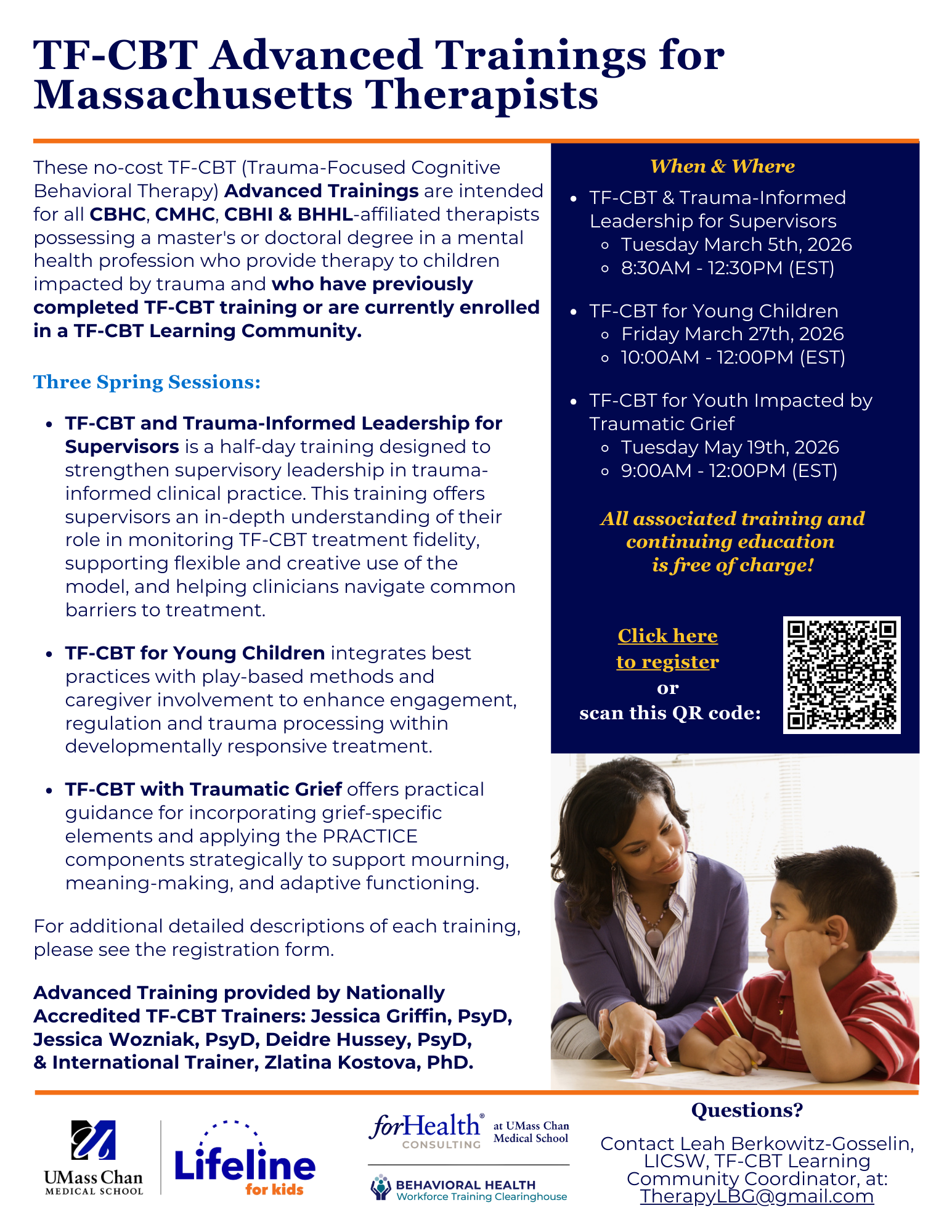
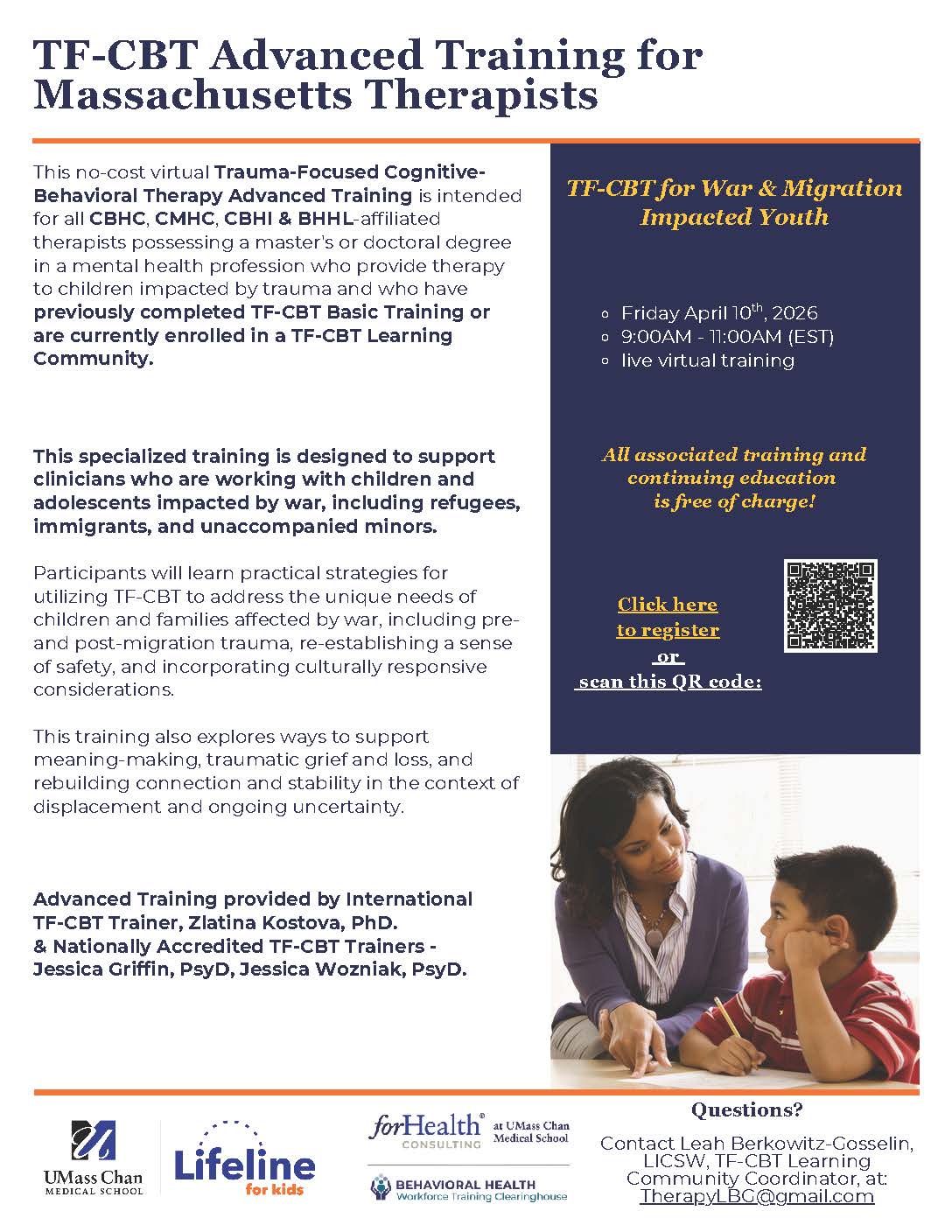
    Trauma Focused Cognitive Behavioral Therapy (TF-CBT) Advanced Training

    Virtual

    Description

    Successful TF-CBT treatment for youth with complex trauma will be explored, as it impacts pacing and each of the PRACTICE components of the model. A themes-based approach to gradual exposure will be reviewed along with tools for earlier integration of the Safety component of the model. A roadmap to the number of TF-CBT sessions focused on the PRAC/coping skills will be shared, with additional strategies offered. 

    Audience: This no-cost TF-CBT (Trauma-Focused Cognitive Behavioral Therapy) Advanced Training is intended for all CBHC, CMHC, CBHI & BHHL-affiliated therapists possessing a master's or doctoral degree in a mental health profession who provide therapy to children impacted by trauma and who have previously completed TF-CBT training or are currently enrolled in a TF-CBT Learning Community.

    When and Where:

    • Chose from one of two dates: December 2, 2025 or February 24, 2026
    • Virtual live webinar - 10:00-2:00 PM EST

    CE Credits: Free CE credits provided to Psychologists, Social Workers, and LMHCs.

    ATs MA TF-CBT Learning Community_MarCom.jpg