Live Instructor-Led Training & Group Consultation

Registration Eligibility

  • Courses and free Continuing Education (CE) and Continuing Medical Education (CME) credits are offered exclusively to MASSACHUSETTS Community Behavioral Health Centers (CBHCs), Mental Health Centers (MHCs), Behavioral Health Help Line (BHHL), and Children’s Behavioral Health Initiative (CBHI) providers.*
  • Your work email MUST be used to register and will be verified.
  • Any ineligible accounts will be deleted.

*If you are interested in gaining access for your organization in or outside of Massachusetts, contact bhclearinghouse@umassmed.edu.

  • September 2026
  • Tue 8

    Strategies for Managing Chronic Absenteeism and School Avoidance

    Virtual

    Description

    Partner program announcement – We are pleased to share this opportunity but it may have an associated cost.

    This workshop is designed to engage participants in thinking about the dynamic challenges clinicians, school staff, and surrogate caregivers face when addressing chronic absenteeism. The goal of this session is to provide context regarding the root causes of absenteeism and the necessity to approach this issue with a holistic lens to effectively minimize its impact. Participants will engage in discourse about how system level responses must meet identity work and mental health services to create individualized care plans to support those experiencing chronic absenteeism. Individuals will come out of the training with a larger toolkit to tailor interventions that more effectively mitigate the needs of their clients and students.

    Chronic-Absenteeism-and-School-Avoidance.png
  • October 2026
  • Fri 9

    Engaging Young Children in Therapy through Play

    Virtual

    Description

    Partner program announcement – We are pleased to share this opportunity but it may have an associated cost.

    In Massachusetts, we are fortunate to have robust Medicaid-supported behavioral health services for children from birth. Early Childhood Mental Health (inclusive of Infant Mental Health and Early Relational Health) has developed into a specialized field of study and scope of practice in the state as well. And yet, non-specialists need to serve infants, toddlers, preschoolers, and their families in the general children’s behavioral health service delivery system. In this workshop, first we will look at a definition of Early Childhood Mental Health and consider its 3 components from the lens of non-specialized behavioral health service providers. Then we will consider the critical step of engaging adults and adolescents in play to treat young children in the context of culture and community. Finally, we will explore using the framework of Regulation-Informed Interactive Play in outpatient and community/home-based therapeutic interventions. Throughout we will pause for self-reflection and skills practice essential to this work. Attendees will leave with increased confidence and capacity to engage young children in therapy through play

    Engaging-Youth-in-Therapy-Through-Play.png
  • Mon 26

    Restorative Practice and Circle: the Fundamentals (Virtual)

    Virtual

    Description

    Partner program announcement – We are pleased to share this opportunity but it may have an associated cost.

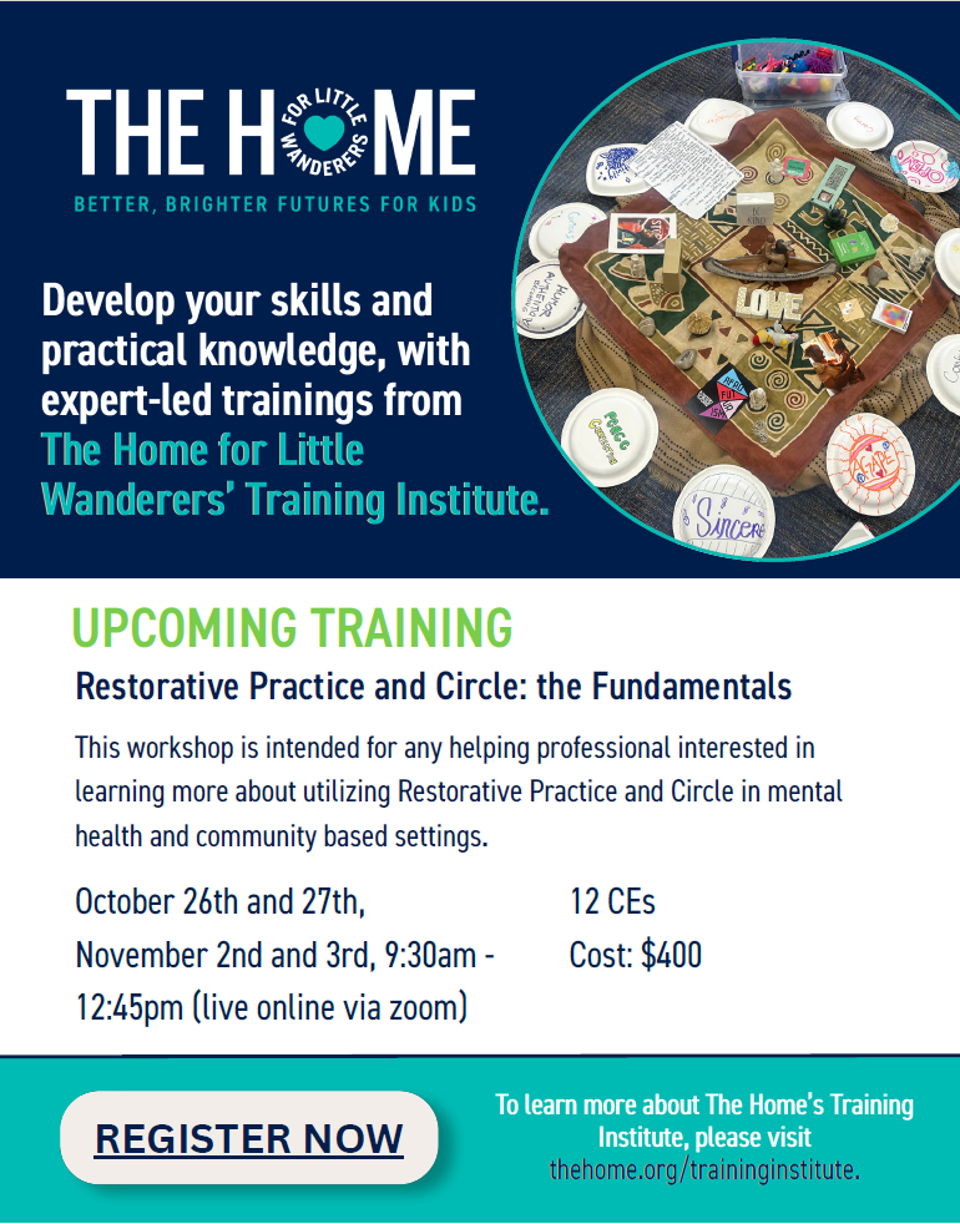
    Restorative Justice is a broad term encompassing a growing social movement to institutionalize peaceful approaches to harm, problem-solving, and violations of legal and human rights. Restorative Practice seeks to balance the needs of the person who was harmed, the person causing harm, and their community(ies) through processes that preserve the safety and dignity for all. Within The Home, Restorative Practice has helped to establish strong relationships by building social and emotional awareness and empathy among clients, families, employees, and administrators. This training will take place in Circle. In the “safe enough” container of Circle, participants will explore their cultural heritage and experiences with power. Through storytelling in Circle, participants will experience the transformative power of being deeply listened to, and co-creating spaces for learning across difference, healing past harm and preventing future harm.

    Restorative-Practice-and-Circle.png
  • Tue 27

    Restorative Practice and Circle: the Fundamentals (Virtual)

    Virtual

    Description

    Partner program announcement – We are pleased to share this opportunity but it may have an associated cost.

    Restorative Justice is a broad term encompassing a growing social movement to institutionalize peaceful approaches to harm, problem-solving, and violations of legal and human rights. Restorative Practice seeks to balance the needs of the person who was harmed, the person causing harm, and their community(ies) through processes that preserve the safety and dignity for all. Within The Home, Restorative Practice has helped to establish strong relationships by building social and emotional awareness and empathy among clients, families, employees, and administrators. This training will take place in Circle. In the “safe enough” container of Circle, participants will explore their cultural heritage and experiences with power. Through storytelling in Circle, participants will experience the transformative power of being deeply listened to, and co-creating spaces for learning across difference, healing past harm and preventing future harm.

    Restorative-Practice-and-Circle.png
  • November 2026
  • Mon 2

    Restorative Practice and Circle: the Fundamentals (Virtual)

    Virtual

    Description

    Partner program announcement – We are pleased to share this opportunity but it may have an associated cost.

    Restorative Justice is a broad term encompassing a growing social movement to institutionalize peaceful approaches to harm, problem-solving, and violations of legal and human rights. Restorative Practice seeks to balance the needs of the person who was harmed, the person causing harm, and their community(ies) through processes that preserve the safety and dignity for all. Within The Home, Restorative Practice has helped to establish strong relationships by building social and emotional awareness and empathy among clients, families, employees, and administrators. This training will take place in Circle. In the “safe enough” container of Circle, participants will explore their cultural heritage and experiences with power. Through storytelling in Circle, participants will experience the transformative power of being deeply listened to, and co-creating spaces for learning across difference, healing past harm and preventing future harm.

    Restorative-Practice-and-Circle.png
  • Tue 3

    Restorative Practice and Circle: the Fundamentals (Virtual)

    Virtual

    Description

    Partner program announcement – We are pleased to share this opportunity but it may have an associated cost.

    Restorative Justice is a broad term encompassing a growing social movement to institutionalize peaceful approaches to harm, problem-solving, and violations of legal and human rights. Restorative Practice seeks to balance the needs of the person who was harmed, the person causing harm, and their community(ies) through processes that preserve the safety and dignity for all. Within The Home, Restorative Practice has helped to establish strong relationships by building social and emotional awareness and empathy among clients, families, employees, and administrators. This training will take place in Circle. In the “safe enough” container of Circle, participants will explore their cultural heritage and experiences with power. Through storytelling in Circle, participants will experience the transformative power of being deeply listened to, and co-creating spaces for learning across difference, healing past harm and preventing future harm.

    Restorative-Practice-and-Circle.png