
Welcome!
As a key component of MassHealth’s Behavioral Health Roadmap for Reform initiative, the BH Clearinghouse is a resource to support the training of Massachusetts Community Behavioral Health Centers (CBHCs), and Behavioral Health Help Line (BHHL) staff. We are excited to add Massachusetts Mental Health Centers (MHCs) and Children’s Behavioral Health Initiative (CBHI) providers to the Clearinghouse!
- Hang this poster in your staff areas to promote this free resource!
- Join us for a Live Support Session to learn how to maximize this resource!
In addition to offering live instructor-led training, the BH Clearinghouse offers a catalog of high-quality self-paced online training in evidence-based behavioral health practices across ten competency areas:
- Clinical Competencies
- Clinical Supervision and Coaching
- Continuing Medical Education for Physicians
- Crisis Intervention
- Cultural Humility
- Evidence-Based Treatment
- State Agency Collaboration
- SUD Assessment and Treatment
- Trauma-Informed
- Youth
- Youth Children’s Behavioral Health Initiative (CBHI) Intensive Care Coordination
Upon successful completion of training, many courses are eligible for free Continuing Education (CE) or Continuing Medical Education (CME) credits. These approvals are listed by course in the Learning Portal.
Upcoming Live Events
-
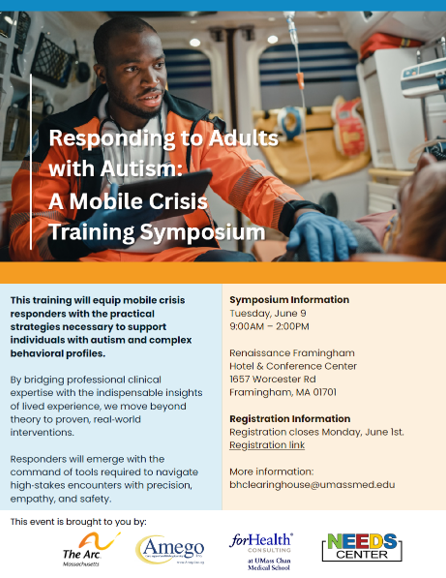
Responding to Adults with Autism: A Mobile Crisis Training Symposium
Application Closed.
This training will equip mobile crisis responders with the practical strategies necessary to support individuals with autism and complex behavioral profiles.
By bridging professional clinical expertise with the indispensable insights of lived experience, we move beyond theory to proven, real‑world interventions.
Responders will emerge with the command of tools required to navigate high‑stakes encounters with precision, empathy, and safety.
-
2026 Virtual Behavioral Health Youth Summit
We are excited to announce that registration is now open for the 2026 Virtual Behavioral Health Youth Summit, hosted by the National Indian Health Board.
This is a free virtual two-day event, and we ask that you share this announcement broadly with your professional networks, particularly those engaged in behavioral health, Tribal health, and youth advocacy.
This two-day FREE virtual summit will take place June 10-11, 2026, and will center on the theme: “Healing Through Culture, Connection, and Youth Leadership.”
This theme reflects NIHB’s ongoing commitment to elevating Native youth voices and advancing behavioral health approaches grounded in culture, community, and Tribal traditions. We invite Tribal leaders, public health professionals, behavioral health practitioners, youth, and advocates to join us for this national convening.
We are honored to welcome our keynote speakers to this year’s summit:
· Day 1: Dr. Glorinda Segay, Division of Behavioral Health Director, Indian Health Service
· Day 2: Dr. Damien Chase Begay, Associate Professor of Social Epidemiology & Indigenous Health, University of Montana School of Public and Community Health Sciences
Daily Schedule (all times listed in Eastern Time):
· 11:00 AM- 1:00 PM: Welcome & Keynote Session
· 1:00 PM- 2:00 PM: Lunch Break
· 2:00 PM- 4:00 PM: Afternoon Sessions
Please register here.
Questions regarding registration or the event program may be directed to: cbellon@nihb.org or tpeterson@nihb.org.
-
2026 Virtual Behavioral Health Youth Summit
We are excited to announce that registration is now open for the 2026 Virtual Behavioral Health Youth Summit, hosted by the National Indian Health Board.
This is a free virtual two-day event, and we ask that you share this announcement broadly with your professional networks, particularly those engaged in behavioral health, Tribal health, and youth advocacy.
This two-day FREE virtual summit will take place June 10-11, 2026, and will center on the theme: “Healing Through Culture, Connection, and Youth Leadership.”
This theme reflects NIHB’s ongoing commitment to elevating Native youth voices and advancing behavioral health approaches grounded in culture, community, and Tribal traditions. We invite Tribal leaders, public health professionals, behavioral health practitioners, youth, and advocates to join us for this national convening.
We are honored to welcome our keynote speakers to this year’s summit:
· Day 1: Dr. Glorinda Segay, Division of Behavioral Health Director, Indian Health Service
· Day 2: Dr. Damien Chase Begay, Associate Professor of Social Epidemiology & Indigenous Health, University of Montana School of Public and Community Health Sciences
Daily Schedule (all times listed in Eastern Time):
· 11:00 AM- 1:00 PM: Welcome & Keynote Session
· 1:00 PM- 2:00 PM: Lunch Break
· 2:00 PM- 4:00 PM: Afternoon Sessions
Please register here.
Questions regarding registration or the event program may be directed to: cbellon@nihb.org or tpeterson@nihb.org.
For more information or to learn more about bringing this training to your state/organization/providers in or outside of Massachusetts, please contact us at: BHClearinghouse@umassmed.edu